| Hungary and Budapest "The Pearl of the Danube" |
| The Danube flows through the center of Budapest, which combines the older city of Buda with the newer Pest on the east side of the river. The Celts, Romans, and Magyars built a series of churches, castles, and forts on the steep Buda hills going back 2000 years. Pest evolved from a medieval commercial town into Budapest's principal shopping and nightlife center, and the principal location of its banks, businesses, and government buildings. Buda and Pest were united in the late 19th century. We stayed two days at the Intercontinental Hotel overlooking the Danube and started our river trip with a night time cruise through the brilliantly illuminated city. |

| The Royal Palace view from our hotel window. And the "Blue" Danube |
| The most interesting part of Budapest is the Castle Hill District which is on a hill within the Buda side of Budapest overlooking the Danube. It contains the city's most important medieval monuments and museums including the Royal Palace shown to the left. We stayed at the Castle Hill Hilton during our 1991 visit to Budapest. We walked through the Castle District, which is only about 3/4 mile and captured some our best pictures of the entire trip. The hillside location provides exceptional views of the river and the landmark buildings on the Pest side. Our first stop was a small art gallery which was dedicated to sculptures and paintings produced by Hungarian artists. The displays were very unusual and we enjoyed some fascinating conversations with the proprietors, one of whom has visited relatives in Sacramento. The pictures below show some of the displays, expensive but unique. |


| We found a bronze sculpture of a rhino that seemed like a perfect birthday present for Jon, but at 5 lbs and $1200, we left it behind. Behind the gallery is small garden filled with unusual sculptures, two of which are shown below. That's Ken taking a photo. |


| The Matthias Church, named after King Matthias Corvinus was built in 1896. The roof of brightly colored tile is typical of many of the historically important buildings in Budapest. The Dracula chamber (a tourist attraction) sign on the right contains the story of Dracula's capture by King Matthias. I always thought Dracula was a myth, but he was the ruler of Transylvania, now part of Romaia. |
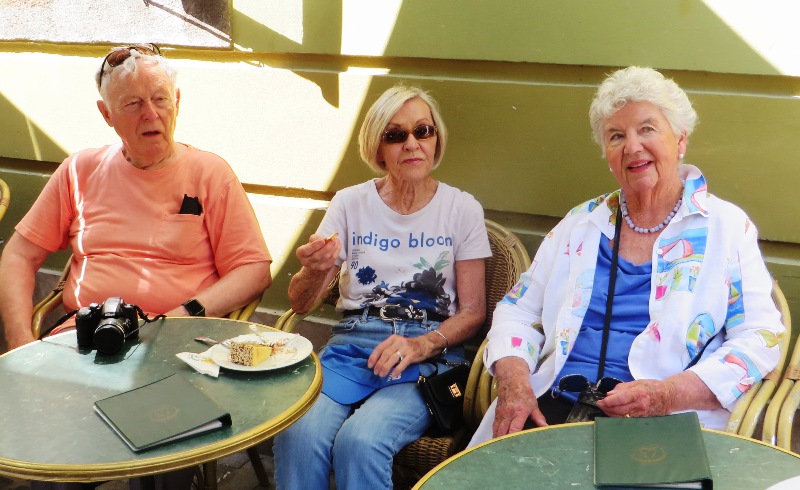
| A delightful cafe where we enjoyed coffees and pastries |
The Fishermen's Bastion dates from 1905; it was named for a medieval guild of
fishermen who were responsible for defending this part of the castle wall. The
views of the Danube and Pest from this vantage point are spectacular.
fishermen who were responsible for defending this part of the castle wall. The
views of the Danube and Pest from this vantage point are spectacular.


| Across the Danube is the magnificent Parliament building |
| The infamous Chain Bridge leads to the Basilica of St Stephen, which is the most sacred Catholic Church in Hungary |
| The dark building below is our hotel |
| Click us bigger |