| Belgrade has been destroyed and rebuilt 40 times. Armies from Europe and the Balkans have fought numerous battles over Belgrade since 300 BC. Over the last 1000 years, control of the city has oscillated between Slavs, Serbs, Hungarians, Ottoman Turks, and eventually the Habsburgs. Under Turkish control, mosques and bath houses sprung up, only to be replaced by churches and palaces under the Habsburgs. Belgrade later suffered further damage as a result of Nazi bombing and NATO attacks to stop Serbia's war with Kosovo in 1999. |
| Belgrade, The Capital of Serbia |
| The Kalemegdan Fortress, located on a hill overlooking the city at the confluence of the Sava and Danube Rivers has been at the center of conflict. We took a walking tour of the fortress and its surrounding park before visiting Belgrade's city center. |


| View of Belgrade city from the fortress hill |
The Sava
The Danube
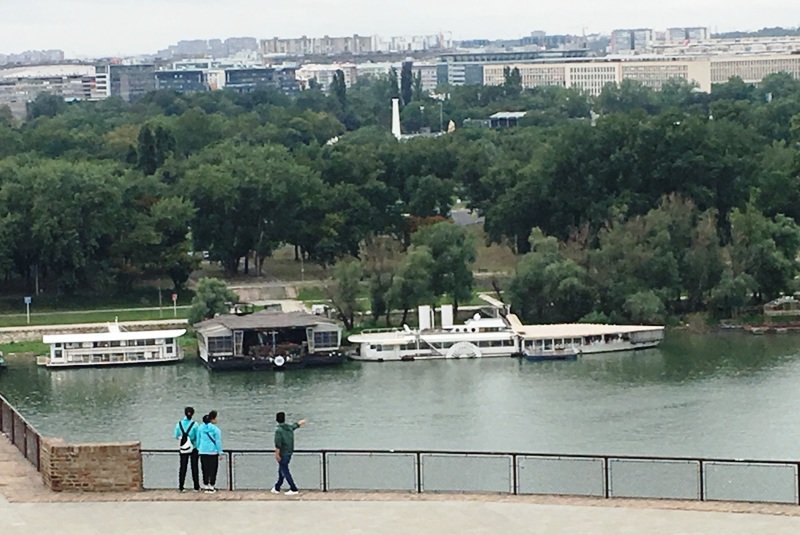
| Night life is centered on restaurants and clubs occupying boats and barges anchored along the rivers. (Click to enlarge) |

Weaponry, old and more recent, remains inside the fortress walls


| The surrounding park contains a "Jurassic Park" and lots of recreational activities. Tennis is very popular in Serbia as a result of Djokovic's emergence as a world class player. |
| The ornnately decorated Church of St Sava is dedicated to Serbia's first archbishop (1169-1236), who not only formed the Serbian church, but also established the foundation of the Serbian state and its culture. Privately funded construction of the church began in the early 19th century and is scheduled to be completed in the next decade. The church will hold a congregation of 11000; it is the second largest Orthodox church in the world. |


| At noon, the church bells ring. The bells are located in the two towers on either side of the dome. The largest bell weighs 6 tons. Very impressive sounds! |

| These photos were taken in the ground floor of the church; the upper two floors are still under construction. |
Listening to the bells tolling
| We also toured the old town of Belgrade where most of the Serbian government buildings are located. Next we attended the most interesting wine tasting event I have experienced anywhere. The tasting took place in tunnels beneath a "Beverly Hills" type residential area. The tunnels were originally built by the Romans and much later used by the Nazis to store ammunition. Today, a section of the tunnels is used to store wine and hold wine tastings; the wine is made elsewhere. The objective of this tasting was to demonstrate how certain foods can add or subtract from the perception of wine quality. The foods included various sausages, cheeses, fruits, and breads. It was an amazing experience! |


| Serbian Parliament |
| National Post Office |

Finance Ministry


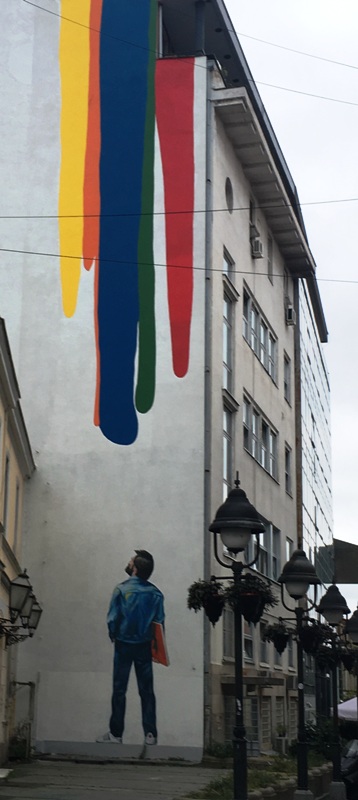
| Lastly, we visited the main shopping street in Belgrade, where the shopping mall is not much different from malls found elsewhere in the world. Starbucks and Nike are very much there. |


| Because of the high humidity, the tunnel walls and floors are wet, but that didn't dampened our spiritsl |